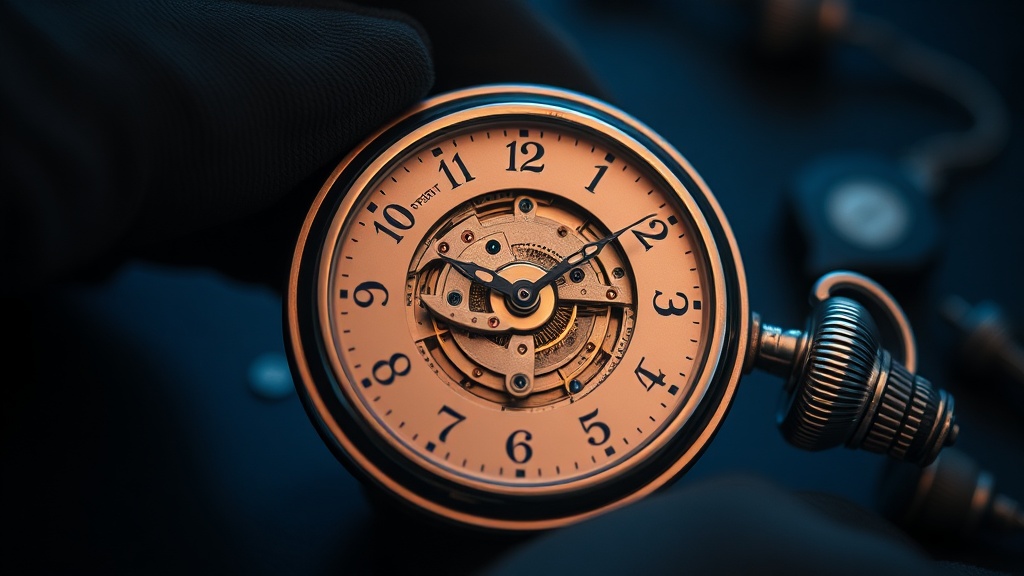
Winding and Setting Your Mechanical Pocket Watch Without Snapping a Mainspring

How do you tell if a pocket watch is lever-set or pendant-set?
You're holding a 1908 Illinois Bunn Special, a piece of railroad history that’s survived two world wars and a dozen owners. You go to wind it, feeling that satisfying rhythmic click, but then you feel a sudden, sharp resistance. If you force it another half-turn, you might hear the dreaded ping of a tempered steel spring shattering inside the barrel. This guide covers how to wind and set your mechanical pocket watch correctly—specifically focusing on identifying the mechanism type and reading the physical feedback the watch gives you—so you don't end up with a costly repair bill.
Many beginners pull on the crown (the knob at the top) expecting it to click out like a modern wristwatch. Do that to a high-grade railroad watch, and you’ll likely bend the setting lever or snap the stem. High-end American pocket watches from companies like Hamilton or Elgin often used a "lever-set" design. This wasn't just a design choice; it was a safety requirement for the railroads. If a conductor's watch crown caught on his uniform and pulled out, he might accidentally change the time, leading to a collision. To check for this, you have to unscrew the front bezel (the ring holding the glass). Look for a tiny metal tab near the 1 or 2 o'clock position. If you see one, use your fingernail to slide it out. Now, turning the crown moves the hands. If there’s no tab, your watch is likely pendant-set, meaning you pull the crown up to move the hands.
The mechanics of the lever-set system
The lever-set system is a beautiful bit of engineering. When you pull that little tab, you're physically shifting a yoke inside the movement. This disconnects the winding wheels and engages the setting wheels. It’s a binary system—it’s either winding or setting, never both. If you try to force the crown into a setting position without pulling the lever, you’re fighting the internal spring tension of the movement. I’ve seen countless watches with "mangled" setting wheels because someone thought the crown was just "stuck" and used pliers. Don't be that person. If you can't find a lever and the crown won't pull up, the watch might be a key-wind model, which requires a specific tool to fit into holes in the back of the inner dust cover.
When should you stop winding a vintage pocket watch?
There’s a common myth that you can "overwind" a watch. Technically, you can’t overwind a watch simply by winding it to the top; you only overwind it if you keep twisting once it hits the stop. Most vintage pocket watches have a mainspring made of blue steel. These springs have a memory, and they’re designed to be wound until they’re tight. You’ll feel the resistance increase gradually as the coils of the spring tighten around the arbor. When you reach the end, the crown will stop moving. It won't be a soft stop; it'll feel like a wall. Stop right there. There's no need to give it that "one last click" for good luck.
If you have a watch with a "wind indicator" (also called a power reserve), you'll see a small hand on the dial moving from zero to 24 or 36. These are common on high-grade railroad watches like the